How to get a Copy of the FIR in False Criminal Cases: Supreme Court Guidelines Explained
If a false criminal case is filed, the accused has the right to receive a copy of the FIR. Here’s what the Supreme Court says, why FIRs are sometimes withheld, and how to apply for a copy under the Youth Bar Association judgment.
Your Right to Receive an FIR Copy When a False Case Is Filed
When a false criminal case is registered, whether it is a false FIR of rape, molestation, or any other allegation one of the most important rights of the accused is immediate access to the FIR copy.
The Supreme Court has made this very clear: an accused person should receive the FIR copy without delay, because such cases directly affect life and personal liberty.
Even under the Right to Information (RTI) Act, an FIR copy should be provided within 48 hours.
Why FIR Copies Are Not Always Available Online
Although most FIRs are now uploaded online on police portals, a major exception exists in cases involving allegations such as:
- Rape
- Sexual assault
- Molestation
To protect the privacy of the complainant, the Supreme Court directed that FIRs in these categories must not be uploaded publicly on the internet.
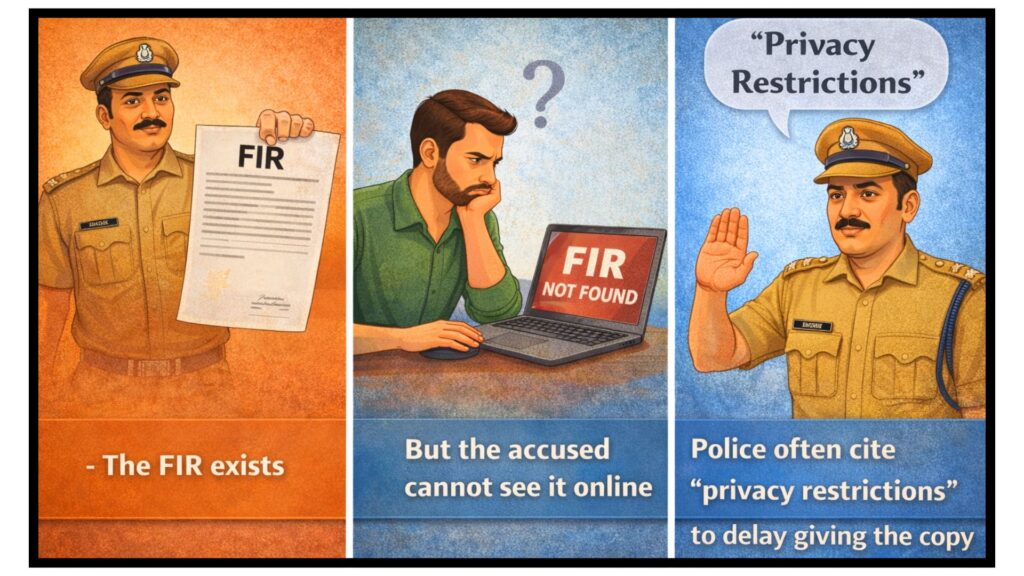
This creates a situation where:
- The FIR exists
- But the accused cannot see it online
- Police often cite “privacy restrictions” to delay giving the copy
This is where ground reality becomes problematic.
The Ground Reality: Police Sometimes Withhold FIR Copies
Despite the legal requirement, FIR copies are often withheld from the accused.
In some cases, police officers:
- Claim there is “an order from above”
- Avoid giving the FIR copy
- Use the situation to extort money from the accused or their family
This creates unjust delays in defending oneself against a false case.
What the Law Allows You to Do: The Youth Bar Association Judgment

When the FIR copy is not being given, there is a clear legal remedy:
File an application before the Magistrate for supply of FIR copy, relying on the Youth Bar Association of India judgment.
According to this judgment:
- The accused has the right to obtain a copy of the FIR
- The Magistrate has the power to direct the police to provide it
- The FIR copy must be supplied within 48 hours
This process is especially important in false FIR cases where the accused is left in the dark about the allegations.
Where to File the Application
The application must be submitted in the court of the Jurisdictional Magistrate, the Magistrate who has authority over:
- The police station where the FIR was registered
- The geographical area of occurrence
Once the application is filed:
- The Magistrate examines it
- The Magistrate issues directions to the police
- The police must provide the FIR copy promptly
This establishes a formal legal route that the police cannot ignore.
Practical Outcome
By using this process, it is possible to obtain a court order that ensures:
👉 Supply of the FIR copy within 48 hours.
This allows the accused to:
- Understand the allegations
- Prepare a defence
- Apply for anticipatory bail (if required)
- Protect their rights in a false case
Access to the FIR is the first step in responding lawfully to criminal accusations.
Conclusion
When a false FIR is filed, the accused has a clear and legally protected right to receive the FIR copy.
Although police may delay or refuse to provide it, the law offers a direct remedy through the Youth Bar Association judgment, enabling the accused to obtain the FIR from the Magistrate’s court within 48 hours.
Understanding this process ensures timely access to information and safeguards the fundamental rights of anyone facing false allegations.
In this video, Amish Aggarwala, Advocate on Record at the Supreme Court of India, discusses the legal position and judicial approach to the issue in the context of matrimonial litigation
