The Common Assumption: “We Both Agreed to Separate, So There’s No Alimony”

A large number of husbands believe:
- Both spouses want a mutual divorce
- The wife initiated the separation
- Therefore, alimony does not arise
However, in Indian divorce proceedings, mutual consent alone does not determine whether alimony will be paid.
Unless both partners have explicitly agreed on the alimony amount including “zero alimony”, it cannot be assumed.
This missing conversation leads to major disputes during the drafting stage.
The Critical Question: Has Alimony Been Clearly Discussed and Decided?
Before drafting any mutual divorce petition, one key question must be addressed:
Have both spouses clearly discussed whether alimony will be paid or not?
In many cases:
- No financial terms have been discussed
- One spouse assumes alimony will not be claimed
- The other spouse remains silent until the paperwork is ready
This silence often leads to misunderstandings and delays during the mutual divorce process.
How Mutual Divorce Paperwork Fails Without Alimony Clarity
A frequent situation in mutual consent divorce cases looks like this:
- One spouse assumes the divorce terms are settled
- Mutual divorce paperwork is prepared mentioning “no alimony”
- The other spouse then objects and raises questions like:
- “What about my alimony?”
- “What about my dowry articles?”
- “What about compensation?”
When financial expectations were never discussed, the draft becomes unacceptable to one spouse, making the entire exercise futile.
The mutual consent process breaks down simply because the core financial terms were never agreed upon.
Why This Happens in Divorce Negotiations
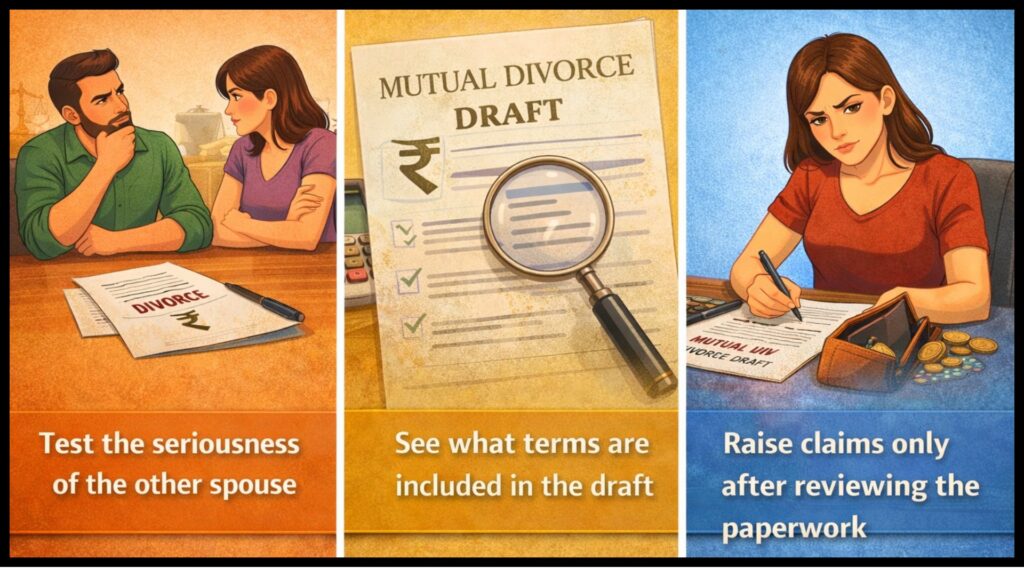
Sometimes a spouse may say, “Prepare the mutual divorce papers,” only to later raise financial issues once the draft is produced.
This may be a way to:
- Test the seriousness of the other spouse
- See what terms are included in the draft
- Raise claims only after reviewing the paperwork
When alimony is missing from the mutual divorce draft, it becomes a trigger for disputes that could have been avoided through an upfront conversation.
The Key Step: Finalise Alimony Before Drafting the Mutual Divorce Petition
Discuss and finalise alimony before starting any paperwork.
This includes confirming:
- Whether alimony will be paid
- The exact amount, if payable
- Whether both agree to zero alimony
- Whether any dowry articles or financial claims remain unresolved
- Whether any compensation is being sought
Only after these points are settled should the mutual divorce petition be drafted.
Conclusion
A mutual divorce truly works smoothly only when both spouses have a clear, explicit understanding of alimony, maintenance, and financial settlement.
Starting the mutual divorce paperwork without addressing these issues often leads to confusion, objections, delays, and a breakdown of the mutual consent process.
Discussing alimony first ensures:
- Genuine mutual agreement
- A clear divorce settlement
- A stable foundation for drafting the mutual divorce petition
- A smoother and conflict-free divorce procedure
A successful mutual divorce begins with financial clarity, not assumptions.
In this video, Amish Aggarwala, Advocate on Record at the Supreme Court of India, discusses the legal position and judicial approach to the issue in the context of matrimonial litigation
